
Over time, search engine optimization, or SEO, has seen significant development. Knowing Google algorithms is crucial if you are a blogger, digital marketer, or business owner.
Many people talk about modern updates, but the early updates shaped today’s SEO world.
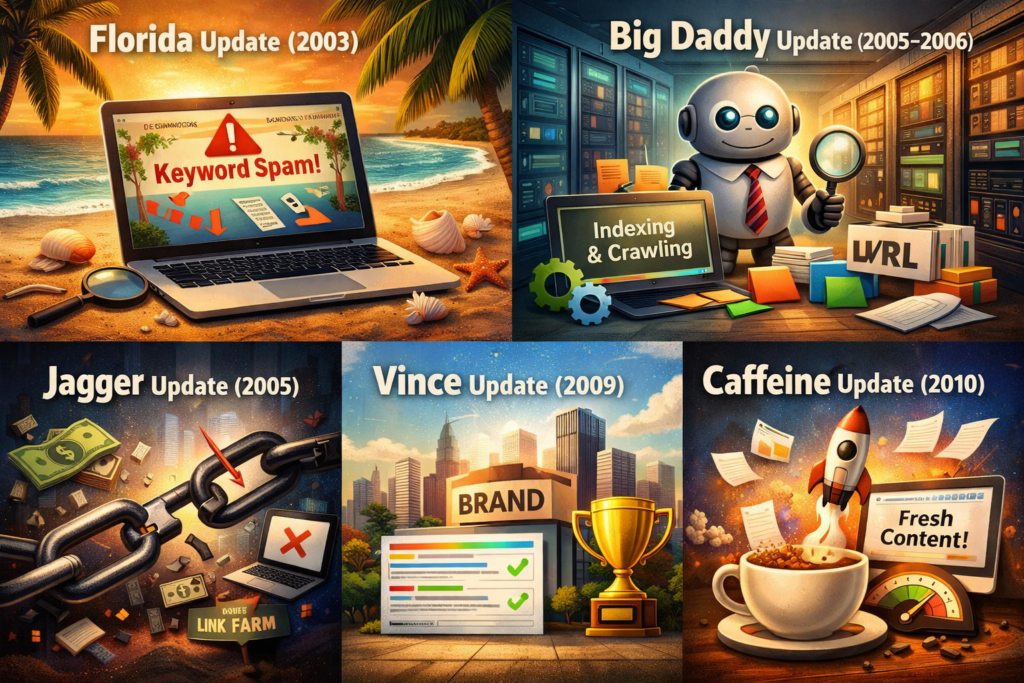
In this blog, we will look at five important Google algorithm updates:
- Florida
- Big Daddy
- Jagger
- Vince
- Caffeine
Let’s break them down in simple English.
Table of Contents
What Are Google Algorithms?
Florida Update (2003)
Big Daddy Update (2005–2006)
Jagger Update (2005)
Vince Update (2009)
Caffeine Update (2010)
Key Lessons for Bloggers Today
Final Thoughts
- Conclusion
1. What Are Google Algorithms?
Google algorithms are systems used by Google to rank websites in search results.
They determine:
Which website appears first
Which page is most relevant to a search query
Which content is high quality
Which sites are considered spam
Google updates these systems regularly to improve user experience and remove low-quality or manipulative content from search results.
Now let’s look at the early updates that shaped modern SEO.
2. Florida Update (2003)
The Florida Update was one of the first major algorithm updates that significantly affected website rankings.
What Happened Before Florida
Websites ranked by repeating keywords excessively.
Affiliate sites dominated many search results.
Content quality was not a major ranking factor.
What Changed After Florida
Keyword stuffing stopped working.
Spammy affiliate websites lost rankings.
Google began prioritizing relevance and content quality.
Why It Was Important
Florida marked the beginning of quality-focused SEO. It proved that shortcuts and tricks would not work in the long term.
Lesson for Bloggers
Avoid keyword stuffing.
Write content naturally.
Focus on user value rather than search engine tricks.

3. Big Daddy Update (2005–2006)
The Big Daddy Update was more technical in nature. It focused on improving Google’s indexing and crawling systems.
What Big Daddy Improved
Better crawling and indexing processes
Improved handling of duplicate content
Enhanced URL structure recognition
Better understanding of canonical issues
Why It Mattered
Although users did not notice dramatic ranking changes, SEO professionals saw improvements in how websites were indexed.
This update helped:
Clean up technical SEO problems
Improve site structure
Increase indexing efficiency
Lesson for Bloggers
Maintain a clean URL structure.
Fix broken links.
Avoid duplicate content issues.
Pay attention to technical SEO foundations.
Content is important, but technical health supports long-term performance.
4. Jagger Update (2005)
The Jagger Update targeted link spam and manipulative backlink practices.
At that time:
Buying links was common.
Link exchanges were widespread.
Many websites used artificial backlink strategies.
What Jagger Targeted
Paid links
Link farms
Unnatural backlinks
Manipulative linking tactics
Impact on Websites
Sites with poor-quality backlinks experienced the following:
Ranking drops
Traffic loss
Reduced trust from Google
Lesson for Bloggers
Focus on earning natural backlinks.
Avoid paid link schemes.
Build authority through high-quality content.
Even today, link quality matters more than link quantity.
5. Vince Update (2009)
The Vince update shifted attention toward brand authority.
What Changed
Established brands began ranking higher.
Trust and authority became stronger ranking signals.
Smaller sites without credibility struggled.
Why Google Made This Change
Google aimed to show the following:
Reliable sources
Trusted businesses
Safer search results
Brands often have:
Strong domain authority
High trust levels
Natural backlink profiles
Lesson for Bloggers
Build a brand, not just a website.
You can strengthen brand signals by:
Publishing consistent content
Building a professional online presence
Earning mentions from reputable sites
Developing author credibility
Brand trust continues to play a major role in modern SEO.
6. Caffeine Update (2010)
The Caffeine update was a major improvement in how Google indexed content. It was not primarily a ranking update.
What Caffeine Improved
Faster indexing
Better handling of fresh content
Improved real-time search
Quicker appearance of new blog posts in search results
Before Caffeine
Content took longer to appear in search results.
After Caffeine
Newly published content appeared much faster.
Why It Was Important
Caffeine supported:
News websites
Active blogs
Trending topics
Frequently updated websites
Lesson for Bloggers
Publish content regularly.
Update existing articles.
Stay relevant to current trends.
Keep your website active.
Freshness became an important part of search visibility.
7. Key Lessons for Bloggers Today
Although these updates were introduced years ago, their core lessons still apply.
Content Quality
Create original and helpful content.
Avoid copying from other sources.
Do not overuse keywords.
Technical SEO
Fix broken links.
Improve page speed.
Maintain a clean website structure.
Natural Backlinks
Earn links through value.
Avoid manipulative tactics.
Brand Building
Build trust and authority.
Show expertise in your niche.
Maintain consistency.
Fresh Content
Update older posts regularly.
Stay aligned with current trends.
Keep publishing consistently.
Modern SEO is no longer about shortcuts. It is about value, trust, and long-term credibility.
8. Final Thoughts
The Florida, Big Daddy, Jagger, Vince, and Caffeine updates shaped the foundation of modern SEO.
They proved that:
Spam tactics do not last.
Quality content is essential.
Technical optimization matters.
Brand authority influences rankings.
Freshness improves visibility.
If you understand these early updates, you understand the core principles of search engine optimization.
Although Google’s systems are more advanced today, the fundamental idea remains the same:
Help users.
Provide value.
Build trust.
That is the true path to long-term success in Google search rankings.
9. Conclusion
The early Google algorithm updates Florida, Big Daddy, Jagger, Vince, and Caffeine did more than change rankings. They changed the way we approach SEO.
These updates made one thing clear: shortcuts do not last. Keyword stuffing, spammy backlinks, weak technical structure, and low-quality content eventually fail. Google continues to refine its systems to reward websites that genuinely help users.
From these updates, we learn that successful blogging depends on the following:
Creating high-quality, original content
Maintaining strong technical SEO foundations
Building natural and trustworthy backlinks
Developing brand authority
Publishing fresh and relevant content consistently
Even though SEO has evolved over the years, the core principle remains the same. Focus on the user first. When your content is helpful, trustworthy, and well-structured, search engines will recognize its value.
In the end, sustainable rankings are not built through tricks. They are built through consistency, credibility, and commitment to delivering real value.